

In an industry built on noise — on applause, spectacle, and carefully constructed farewells — silence is rare.
And when it appears, it means something.
That’s what made that single sentence from Sylvester Stallone feel so unusually heavy. Not because of what it said. But because of everything it didn’t.
“I had a great time working with Chuck.”
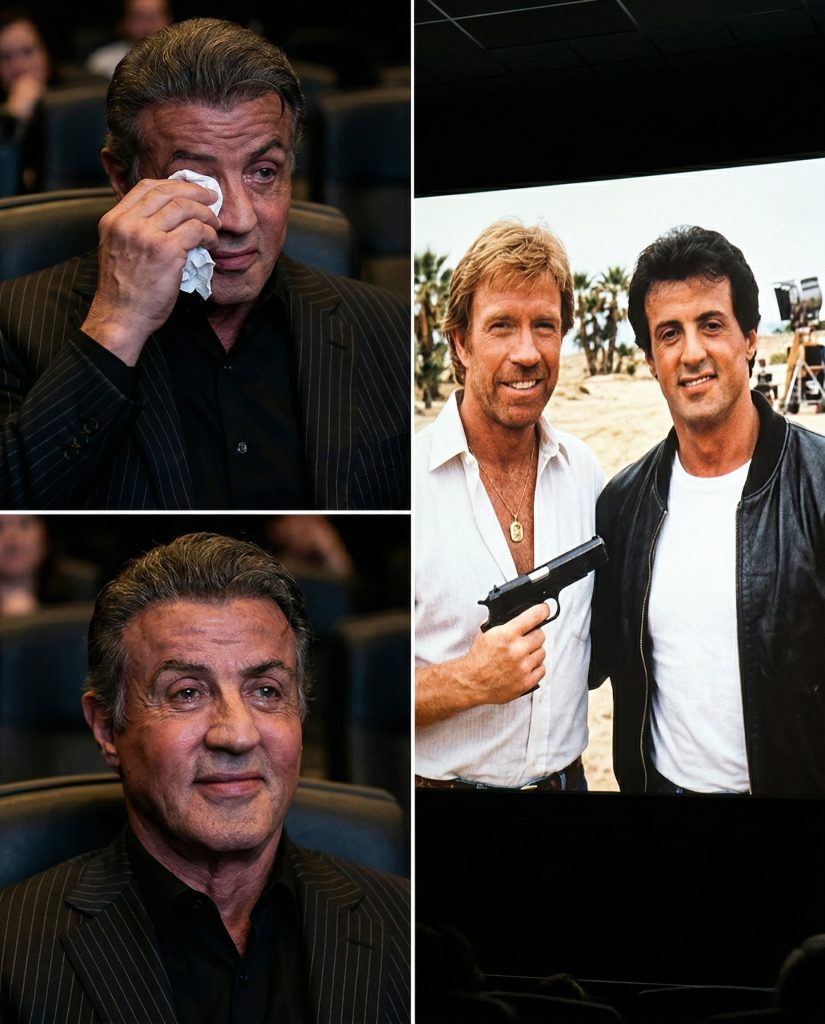
No dramatic pause.
No emotional crescendo.
No carefully crafted tribute designed to echo across headlines.
Just a line. Plain. Direct. Almost… understated.
And yet, for those who have watched both men for decades — who understand what they represent — that line carried a weight that words rarely achieve.
A DIFFERENT KIND OF RESPECT
Hollywood is no stranger to tribute culture. When legends pass, the pattern is familiar: long speeches, emotional interviews, carefully selected memories polished for public consumption.
But Stallone didn’t follow that script.
He didn’t need to.
Because what existed between him and Chuck Norris was never built for the public.
It wasn’t rivalry.
It wasn’t collaboration for headlines.
It wasn’t a manufactured “icon meets icon” moment designed for marketing.
It was something quieter.
Something older.
Something closer to recognition.
TWO MEN FROM THE SAME WORLD
To understand the silence, you have to understand the world they came from.
Both Stallone and Norris built their identities in an era before CGI dominance — when physical presence mattered more than visual effects, when credibility wasn’t edited in post-production.
They weren’t just actors.
They were embodiments of something.
- Discipline
- Endurance
- Restraint
- And a kind of masculinity that didn’t need explanation
But even within that shared space, there was a difference.
Stallone was the storyteller — the architect of characters like Rocky and Rambo, men who fought not just opponents, but themselves.
Norris was something else entirely.
He didn’t play strength.
He represented it.
THE PRESENCE YOU DON’T PERFORM
There’s a reason people often describe Chuck Norris differently than other action stars.
Not louder.
Not more charismatic.
Not more dramatic.
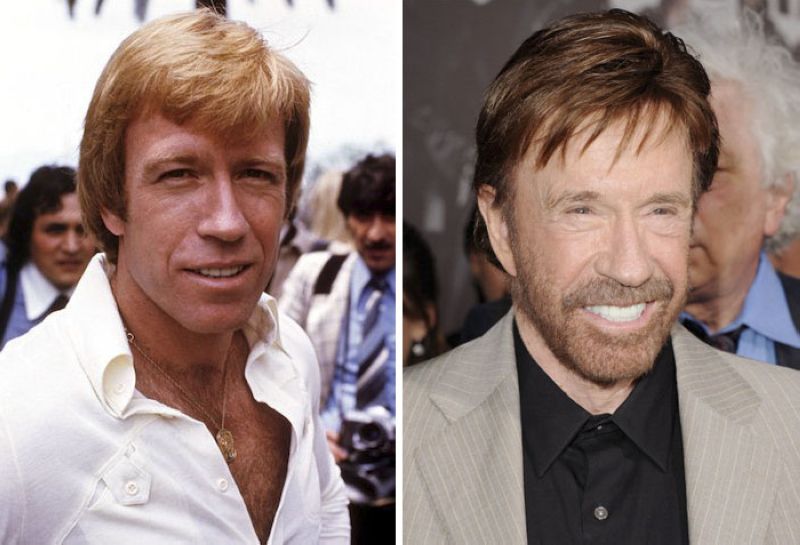
Just… more real.
He didn’t need to raise his voice.
He didn’t need extended monologues.
He didn’t need emotional breakdown scenes to prove depth.
Because his presence did the work.
And that’s something Stallone understood — perhaps better than most.
Because it’s something you can’t fake.
You either have it…
Or you spend a career trying to simulate it.
WHAT STALLONE DIDN’T SAY
When Stallone added:
“He was All American in every way.”
It sounded simple.
But in context, it wasn’t.
Because that phrase — “All American” — doesn’t just describe nationality.
It describes a code.
- Self-reliance
- Moral clarity
- Quiet strength
- Loyalty without performance
And when one icon uses that phrase to describe another, it isn’t casual.
It’s classification.
It’s acknowledgment.
It’s one man recognizing another as belonging to the same unspoken standard.
THE SILENCE BETWEEN SCENES
People often imagine what it must have been like when these two shared space.
Not necessarily in front of cameras — but in the moments between.
No need for small talk.
No need for ego.
No need to prove anything.
Because when two men have already proven everything — to themselves, to audiences, to time — conversation changes.
It becomes quieter.
More precise.
More real.
And sometimes…
It disappears entirely.

WHY SIMPLE WORDS HIT HARDER
There’s a reason Stallone didn’t write a long tribute.
Because long tributes are often for the audience.
Short ones?
They’re usually for the person.
“I had a great time working with Chuck.”
That’s not a statement meant to impress.
That’s a memory.
And memories don’t need decoration.
A RELATIONSHIP THE PUBLIC NEVER SAW
Hollywood thrives on visible relationships.
Friendships are photographed.
Collaborations are promoted.
Conflicts are amplified.
But the most real connections?
They often exist outside of all that.
There was no ongoing media narrative about Stallone and Norris.
No headline-driven dynamic.
No public rivalry.
No carefully staged friendship.
Which is exactly why that single line felt so genuine.
Because it wasn’t part of a story.
It revealed one.
THE DIFFERENCE BETWEEN LEGENDS AND ICONS
Not every icon becomes a legend.
Icons are remembered for moments.
Legends are remembered for what they represent.
Chuck Norris became something more than a film figure.
He became a symbol.
Not through marketing.
Not through reinvention.
But through consistency.
He never needed to evolve into something else to stay relevant.
He stayed exactly who he was.
And somehow, that became timeless.
WHY OTHER LEGENDS STAYED QUIET
The most telling part of this moment wasn’t just Stallone’s words.
It was the absence of noise from others.
No exaggerated tributes.
No competition to deliver the most emotional farewell.
No attempt to “out-speak” the moment.
Because when someone represents something foundational…
You don’t compete with it.
You step back.
You acknowledge.
And sometimes…
You stay silent.
THE WEIGHT OF A LIFE WITHOUT PERFORMANCE
In modern culture, everything is amplified.
Emotion is performed.
Grief is shared publicly.
Respect is often measured by visibility.
But Chuck Norris came from a different time.
A time when:
- You didn’t explain your strength
- You didn’t advertise your values
- You didn’t need validation from an audience
And perhaps that’s why the response to him felt different.
Because the man himself never asked for attention.

WHAT THIS MOMENT REALLY SHOWED
This wasn’t just about Stallone.
It wasn’t just about Norris.
It was about something bigger.
A disappearing kind of presence.
A way of being that doesn’t rely on noise.
A kind of respect that doesn’t need explanation.
THE FINAL IMPRESSION
In the end, what people remember most isn’t always what’s said.
It’s what’s felt.
And in this case, what people felt was unmistakable:
- No spectacle
- No performance
- No exaggeration
Just one man…
acknowledging another.
Quietly.
Honestly.
Completely.
AND MAYBE THAT WAS THE POINT
Because sometimes, the most powerful tribute isn’t the one that says everything.
It’s the one that leaves space.
Space for meaning.
Space for memory.
Space for understanding.
“I had a great time working with Chuck.”
Simple.
But not small.

And now, people are left with a question that lingers longer than any speech ever could:
Was that just a sentence…
Or was it everything that needed to be said?